Vercel Breach Exposes the Fragility of Cloud-Dependent Crypto Infrastructure
Vercel's breach via compromised AI tool exposed crypto API keys. Analysis of cloud dependency risks and why hardware-anchored, offline architecture matters.
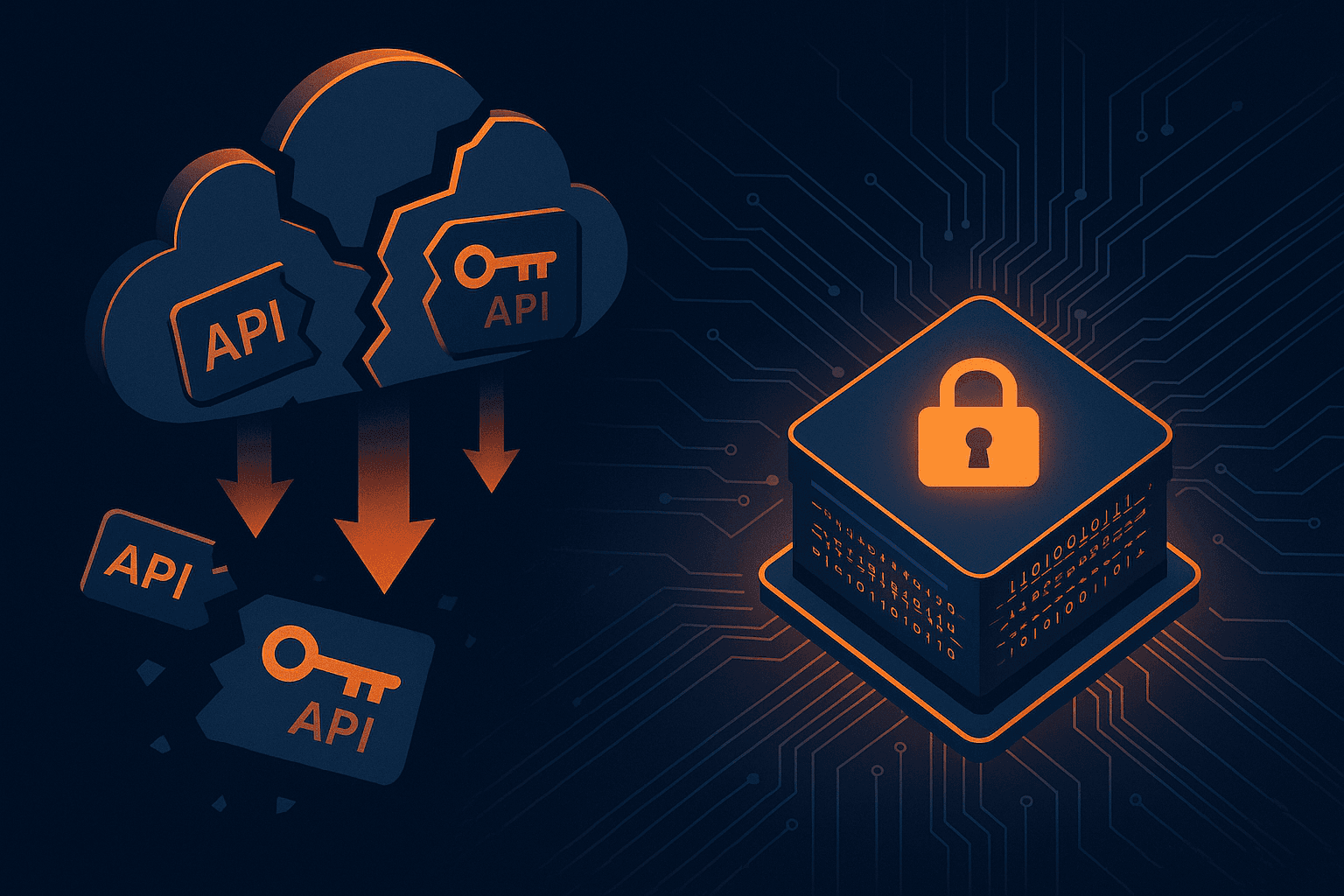
Web infrastructure provider Vercel disclosed a security breach on April 19, 2026, traced to a compromised Google Workspace connection through third-party AI tool Context.ai. The intrusion potentially exposed customer API keys—credentials that connect frontend applications to backend services, databases, and blockchain providers. While Vercel maintains that "sensitive" environment variables are stored in encrypted form and found no evidence of access, numerous crypto projects including Solana DEX Orca scrambled to rotate credentials. A post on BreachForums claims to offer Vercel data including access keys and source code for $2 million, though verification remains pending.
The incident matters because Vercel hosts frontend infrastructure for a significant portion of Web3 applications. These frontends—the user-facing interfaces that connect wallets to trading platforms and DeFi protocols—rely on environment variables to store credentials connecting them to blockchain data providers and backend services. The breach underscores a fundamental architectural tension: decentralized protocols running on centralized infrastructure, where the weakest link isn't the blockchain itself but the cloud platforms hosting the access layer.
The Supply Chain Attack Surface
Vercel's breach originated from Context.ai, an AI productivity tool used by an employee. The compromised Google Workspace connection allowed attackers to escalate privileges into Vercel's internal environments—a textbook supply chain attack exploiting trusted third-party integrations. Vercel is the primary steward of Next.js, one of the most widely adopted web development frameworks, making the scope of potential exposure difficult to quantify.
Modern development infrastructure consists of layered dependencies: developers trust their tools, those tools trust authentication providers, and authentication providers trust their own security posture. Each layer introduces risk. The Context.ai compromise demonstrates how a single weak link—a third-party AI tool with overly permissive access—can cascade through the entire stack. Attackers don't need to breach the primary target directly when they can compromise a vendor with privileged access.
API keys present particular risk because they function as bearer tokens. Unlike user credentials that can be rate-limited or geofenced, API keys grant programmatic access designed for high-volume automated operations. A leaked key to a blockchain data provider could allow attackers to manipulate data feeds, exhaust usage quotas, or monitor transaction patterns. A compromised deployment credential could enable code injection into production frontends that handle wallet connections.
Cloud Infrastructure as a Trust Boundary
Vercel's statement that "sensitive" environment variables are encrypted at rest and showed no evidence of access offers limited reassurance. The encryption protects data on disk, but environment variables must be decrypted to function—they need to be readable by the deployment system to inject them into running applications. An attacker with sufficient internal access could potentially intercept credentials during deployment or runtime initialization.
The broader issue isn't whether Vercel's encryption implementation failed in this specific case. The issue is structural: cloud-hosted infrastructure requires trusting the provider's security controls, incident response capabilities, and internal access policies. You're delegating custody of sensitive credentials to a third party whose infrastructure you can't audit and whose breach notification you can't verify independently.
This dependency creates asymmetric risk for crypto applications. Traditional web applications might tolerate a compromised API key by rotating credentials and monitoring for suspicious activity. Crypto applications face different stakes. A leaked key to a wallet service or transaction relay could enable theft of user funds. A compromised deployment credential could allow attackers to inject malicious code that siphons private keys when users connect their wallets.
Offline-First Architecture as Defense
UltraLocked's design philosophy addresses this class of threat through architectural exclusion rather than hardening. The application contains zero networking code. Files stored in the vault never transit network connections, never touch cloud infrastructure, and never rely on external services to maintain confidentiality.
The Secure Enclave handles all cryptographic operations on-device within Apple's dedicated security coprocessor. Encryption keys are generated in hardware and never exist in extractable form—not in application memory, not in device storage, not in cloud backups. Each file receives a unique ephemeral key through Perfect Forward Secrecy, meaning compromise of one file provides zero cryptographic advantage toward decrypting others.
This architecture eliminates entire categories of attack surface. No API keys exist because no APIs are called. No environment variables hold sensitive credentials because no external services require authentication. No third-party integrations introduce supply chain risk because no integrations exist. The attack surface reduces to physical device access and the security posture of Apple's silicon-level cryptographic implementation.
For crypto holders storing seed phrases and private keys, the implications are direct. Vercel's breach demonstrates how cloud-dependent infrastructure creates exposure points far removed from the user's security practices. You can follow perfect operational security—hardware wallets, air-gapped signing, VPN usage—and still face risk if the frontend interface you use to interact with DeFi protocols stores its API credentials on compromised infrastructure.
Relevant Security Controls
UltraLocked's crypto secrets vault implements specific protections for seed phrase and private key storage. BIP-39 validation ensures 12, 18, and 24-word mnemonics meet specification with correct checksums. Shamir Secret Sharing allows splitting secrets into multiple shares with configurable threshold recovery—default 2-of-3 means you can lose one share and still reconstitute the secret.
Reveal delays introduce temporal friction before viewing stored secrets, configurable from instant to 24 hours. Threat-aware reveal automatically blocks access when screen recording is active, AirPlay is enabled, a debugger is attached, or duress mode is triggered. These controls reduce risk from shoulder surfing, malware attempting screen capture, or coerced access scenarios.
Duress codes provide plausible deniability through alternative PINs that open decoy vaults while silently destroying real data. For travelers crossing hostile borders or facing device inspection demands, duress functionality creates a credible false bottom that doesn't appear empty or suspicious.
The air-gapped file transfer system enables moving encrypted files between devices using only camera and screen—no WiFi, Bluetooth, or cellular required. Elliptic curve Diffie-Hellman key exchange (P-256) establishes ephemeral session keys, with AES-256-GCM encrypting each QR code frame. Short authentication string verification prevents man-in-the-middle attacks through verbal confirmation of a 6-character code. Fountain coding provides forward error correction, allowing successful transfer even with 50%+ frame loss from poor lighting or camera quality.
Guidance for High-Value Credential Storage
The Vercel breach reinforces that cloud infrastructure—regardless of provider reputation or security certifications—introduces trust dependencies and expanded attack surface. For credentials that control significant financial value or access to irreplaceable data, evaluate whether cloud convenience justifies the architectural risk.
Seed phrases and private keys controlling substantial crypto holdings don't belong in cloud password managers, browser extensions, or any system dependent on vendor security posture. Hardware-anchored storage with offline-first architecture eliminates exposure to vendor breaches, supply chain compromises, and insider threats.
For professionals handling confidential information under legal privilege, regulatory compliance, or fiduciary duty, consider whether your current storage architecture would survive disclosure in litigation. "The cloud provider was breached" provides little protection against malpractice claims or regulatory penalties when client data leaks.
Don't assume vendor assurances about encryption provide meaningful protection. Encryption at rest protects against physical disk theft, not against attackers who compromise the infrastructure with sufficient privilege to access decryption keys or intercept data in memory. If the vendor can decrypt your data to make it functional, an attacker who compromises the vendor may gain the same capability.
For time-sensitive confidential files, self-destruct timers provide defense against future compromise. Files automatically deleted after configured periods—5 minutes to custom durations—don't exist in forensic recovery scenarios. Dead man's switch auto-wipe adds protection when extended device access occurs without user check-in, relevant for international travel or detention scenarios.
April 2026 is shaping up as one of the worst months for crypto exploits this year. Drift Protocol lost $285 million to North Korea-linked actors earlier in the month. Kelp DAO's $292 million rsETH exploit triggered cascading DeFi liquidations the same weekend as the Vercel breach. CoW Swap, Zerion, Rhea Finance, and Silo Finance all suffered smaller compromises in the intervening weeks.
Pattern recognition matters. The attack surface keeps expanding as Web3 infrastructure layers on traditional cloud platforms, AI productivity tools, and third-party integrations. Each new dependency introduces risk. The only dependency you can truly audit is the one you eliminate.